Let’s be frank: manufacturers are no longer satisfied with traditional automation solutions and instead are seeking intelligent technology that can allow them to navigate the demands of today’s dynamic market more easily. Flexible automation technology enables adjustments on the fly without destroying the return on investment (ROI), but navigating the assessment process for sizable investments like these can feel daunting—until now. Let’s dive in on how to achieve more promising financial returns on automation investments going forward.
Three Common Pitfalls That Impact Payback Time
One of the key metrics used for reviewing automation investment proposals is payback time, which accounts for both estimated costs and estimated savings. The investment is more likely to be approved if the payback time is under one year; anything over three years is less likely to be approved. For example, a solution that costs $1M with $500K in savings per year could have a payback time of approximately two years.
The biggest surprises for any manufacturer investing in automation lie in the assumptions made with these upfront estimates. If they’re extremely conservative and account for the full variability of uncertainty, there is a better chance of achieving a strong return. But usually, manufacturers take a short-term outlook, with aggressive assumptions that support capital expenditure (CapEx) approval, which impacts ROI later on. Here’s what happens when aggressive assumptions are made:
-
- Requirements aren’t captured fully, and the cost is higher than initially estimated.
When requirements for the line(s) aren’t fully captured, engineering change orders (ECOs) will likely be needed before deployment—and these can get costly, fast. The estimated cost could quickly increase from $1M to $1.5M with $500K savings per year, pushing the payback time out to three years.
- Demand is lower than initially expected, so savings are lower than initially estimated.
Due to volatile market conditions, there may be high demand this month and low demand next month, making it difficult to forecast demand and set the capacity of the line. When overall demand is significantly lower than initially expected, a hard-coded automation line is going to fail to realize the estimated savings because instead of running two shifts, only one shift might be needed for the line. It could now cost $1M but with only $250K instead of $500K in savings, resulting in a payback time of four years.
- New product versions are introduced, reducing savings due to longer changeover times.
Manufacturers typically need to introduce new product versions based on market feedback, which requires ECOs to accommodate assembly changes related to the new product versions. These changes drive up cost while at the same time, reducing savings as more time is needed to handle required product changeovers, which now includes more product versions. The cost could increase to $1.2M, and the savings could decrease to $400K, taking the payback time to three years.
How to Avoid Pitfalls with an Intelligent Automation Platform
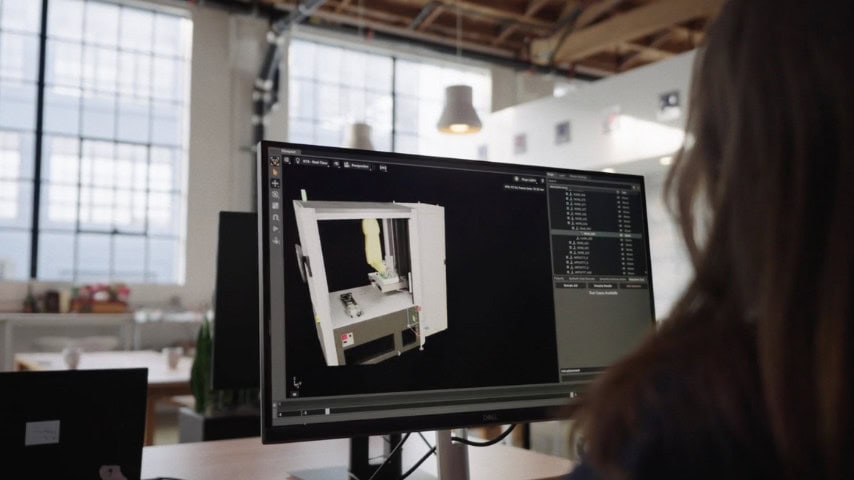
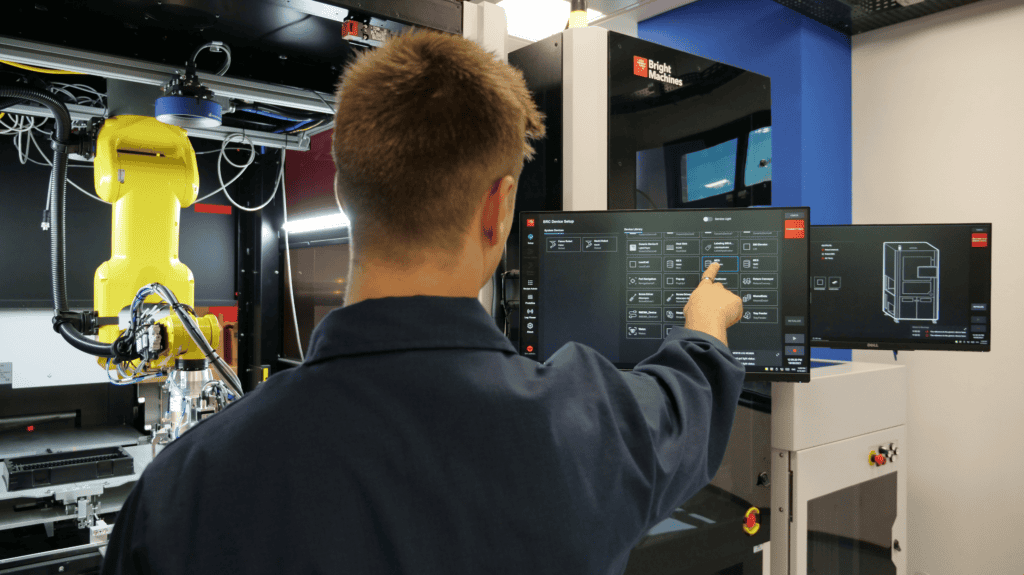
An intelligent platform approach like the Bright Machines® Microfactory helps manufacturers avoid these pitfalls. Rather than customized, hard-coded lines, intelligent platform architecture provides a standard operating system and software-based configuration that allows manufacturers to modify as needed. This results in:
- Flexible implementation: Microfactories decrease the risk of missing requirements because the process is not started from scratch. Even if something is left out, our modular hardware makes it easier to add or remove elements on the line. It also safeguards manufacturers from fluctuating demand because they can remove modular robotic cells from the line to reduce capacity and reuse the removed cells on other lines as needed. Then, as demand changes, line capacity can be right-sized accordingly.
- Shorter product changeover times: Our intelligent platform approach enables manufacturers to pivot quickly as new product versions are introduced by providing the ability to run multiple SKUs on the same line—resulting in shorter product changeover times that contribute to savings.
- Fewer surprises that impact ROI: An intelligent platform like the microfactory results in fewer ECOs—but if ECOs are needed, they’re also less expensive. By having the “building blocks” through software-based configuration, reconfiguration time is minimized. Nearly 70-80% of hardware modules can be reused as well, which helps extend the life of equipment, resulting in an even better ROI.
Making the case for automation investments is inherently easier when championing intelligent, flexible solutions over traditional rigid ones. Plus, the agile nature of an intelligent platform approach results in better financial returns. It’s a win-win.
To learn more about our offerings, please visit our Capabilities page.